SLAC and Stanford researchers find an inexpensive way to make batteries last longer
By adjusting the heating process when making lithium-ion cathodes, the team created batteries that retained nearly 93% of their energy after 500 cycles.
By Emily Ayshford
Key takeaways:
- Cathodes within lithium-ion batteries crack after repeated charging and discharging due to nanoscale imperfections.
- Researchers at the SLAC-Stanford Battery Center adjusted the heating process when making the cathodes to create more uniform nanoscale structures.
- The result is longer-lasting lithium-ion batteries that don’t require any extra chemicals or manufacturing steps.
To make batteries that last longer, scientists are creating internal battery structures that don’t degrade as quickly as current designs do. In fact, the reason many lithium-ion batteries ultimately fail is that their cathodes, or negative electrodes, crack after repeated charging and discharging.
SLAC-Stanford Battery Center
The center leverages the strengths of a top-tier university, a premier national laboratory and silicon valley to accelerate battery and energy storage technologies.

Researchers at the SLAC-Stanford Battery Center, a partnership between Stanford University’s Precourt Institute for Energy and the Department of Energy’s SLAC National Accelerator Laboratory, have found a simple way to solve this problem in nickel-rich layered-oxide cathodes, the type of cathode used in powerful, long-lasting lithium-ion batteries for data centers and grid-scale energy storage.
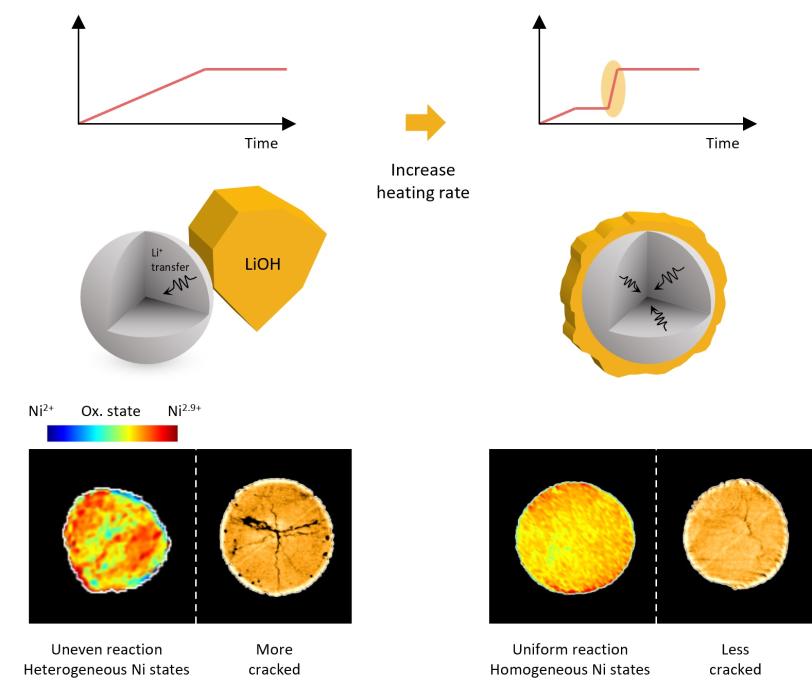
By adjusting the heating process when making these cathodes – starting slowly, then ramping up the heat quickly – they found they could create more uniform cathode structures at the nanoscale level. These structures don’t crack and degrade as quickly as current batteries.
The resulting material was more resistant to strain and cracking, retaining nearly 93% of the battery’s energy after 500 cycles.
“This is on par with the best energy retention metrics that we can find from similar batteries,” said William Chueh, director of the Stanford Precourt Institute for Energy and the SLAC-Stanford Battery Center. “Our team has found a way to avoid extra manufacturing steps and higher costs but still get longer-lasting batteries.”
The result, published in Nature Energy, could lay the groundwork for longer-lasting lithium-ion batteries that require no extra chemicals or coatings during production.
“Sometimes the simplest knob is the most powerful,” said Donggun Eum, a postdoctoral researcher at Stanford and SLAC and first author on the paper. “By carefully controlling the heating step, we were able to dramatically improve the battery’s stability, without changing its chemistry.”
“It has been taken for granted in the industry that this problem exists and that you have to find an expensive way around it,” said Hari Ramachandran, a former Stanford graduate student and the other first author. “But we found a way to take the simplest starting ingredients and create better batteries without any more cost or difficulty.”
Finding the right melting rate
To create certain kinds of layered-oxide cathodes for these lithium-ion batteries, scientists melt lithium hydroxide with solid particles of a nickel-rich transition-metal hydroxide precursor. But as the materials connect and react during the standard slow melting process, they can create uneven internal microstructures inside the cathode particles.
“When different regions inside a particle react at different times, some are more stressed than others when the battery charges and discharges, which leads to cracking and fracturing,” Eum said.
Other research teams have dealt with these uneven internal structures by either adding dopants or applying coatings to stabilize the particles. These strategies introduce new costs and steps to the battery production process.
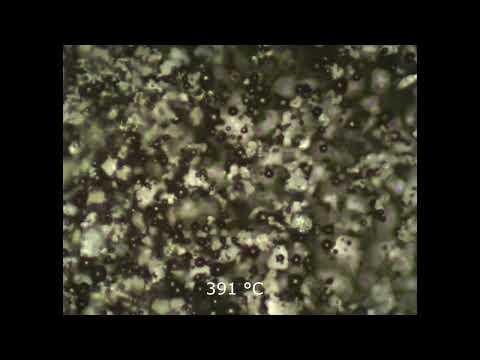
Synthesis of lithium-ion cathode materials for batteries
The SLAC-Stanford research team took a different approach. Instead of changing the chemistry, they sought to take advantage of the melting process. By increasing the heating rate, they aimed to generate more molten lithium hydroxide and allow the materials to react more evenly.
Working with researchers at the National Synchrotron Light Source II (NSLS-II) at DOE’s Brookhaven National Laboratory, the team used transmission X-ray microscopy to observe the reaction as it took place.
At SLAC’s Stanford Synchrotron Radiation Lightsource (SSRL), the team used X-ray absorption spectroscopy and X-ray diffraction to monitor chemical and structural changes during synthesis of the cathode materials. The data showed how lithiation progresses under different heating conditions and how the layered structure forms and evolves as the temperature increases.
The researchers discovered that heating the materials slowly for several hours made the precursor materials decompose and release water slowly enough to avoid the formation of porous structures. Once that occurred, the team increased the heat, melting the lithium hydroxide to create a more uniform internal structure within the particles.
The team plans to scale the technique to industrial-sized furnaces and extend this approach to other cathode chemistries, establishing a new design rule for this synthesis method.

How the Stanford-SLAC Battery Center is making batteries better
Other contributors include the University of Texas, Austin, as well as Korea University, the Research Institute of Industrial Science and Technology, and Kyungpook National University, all in Korea. Additional microscopy work was conducted at Pohang Light Source II (PLS-II) at Pohang Accelerator Laboratory, Korea. SSRL and NSLS-II are DOE Office of Science user facilities. This work was supported by the California Research Alliance; the U.S. Air Force Office Multidisciplinary University Research Initiative program; and by DOE’s Technologies Transportation Office, Office of Critical Minerals and Energy Innovation.
Citation: D. Eum et al., Nature Energy, 2 March 2026 (s41560-026-01988-w).
For media inquiries, please contact media@slac.stanford.edu. For other questions or comments, contact SLAC Strategic Communications & External Affairs at communications@slac.stanford.edu.
About SLAC
SLAC National Accelerator Laboratory explores how the universe works at the biggest, smallest and fastest scales and invents powerful tools used by researchers around the globe. As world leaders in ultrafast science and bold explorers of the physics of the universe, we forge new ground in understanding our origins and building a healthier and more sustainable future. Our discovery and innovation help develop new materials and chemical processes and open unprecedented views of the cosmos and life’s most delicate machinery. Building on more than 60 years of visionary research, we help shape the future by advancing areas such as quantum technology, scientific computing and the development of next-generation accelerators.
SLAC is operated by Stanford University for the U.S. Department of Energy’s Office of Science. The Office of Science is the single largest supporter of basic research in the physical sciences in the United States and is working to address some of the most pressing challenges of our time.